Granular Insights (Corteva)
Re-architecting the product around a new primary user
Role and Team: Design lead + sole designer for the build team · Project leads (PM, Eng) + a development team (PM, 4 engineers)
Insights was built in 2019 for farmers. Not long after Corteva acquired Granular, strategy shifted to make independent seed reps the primary user. I noticed a mismatch between how reps worked and how our app was organized so I led the effort to rebuild the IA around rep workflows. This became Corteva’s “New Rep Experience” initiative. Because it was high-risk and touched nearly every team, I split it into three more managable workstreams (main navigation, data navigation, and context setting). I worked in a dual role: setting the vision and aligning stakeholders across product, engineering and architecture while doing the hands-on design for my eng team.
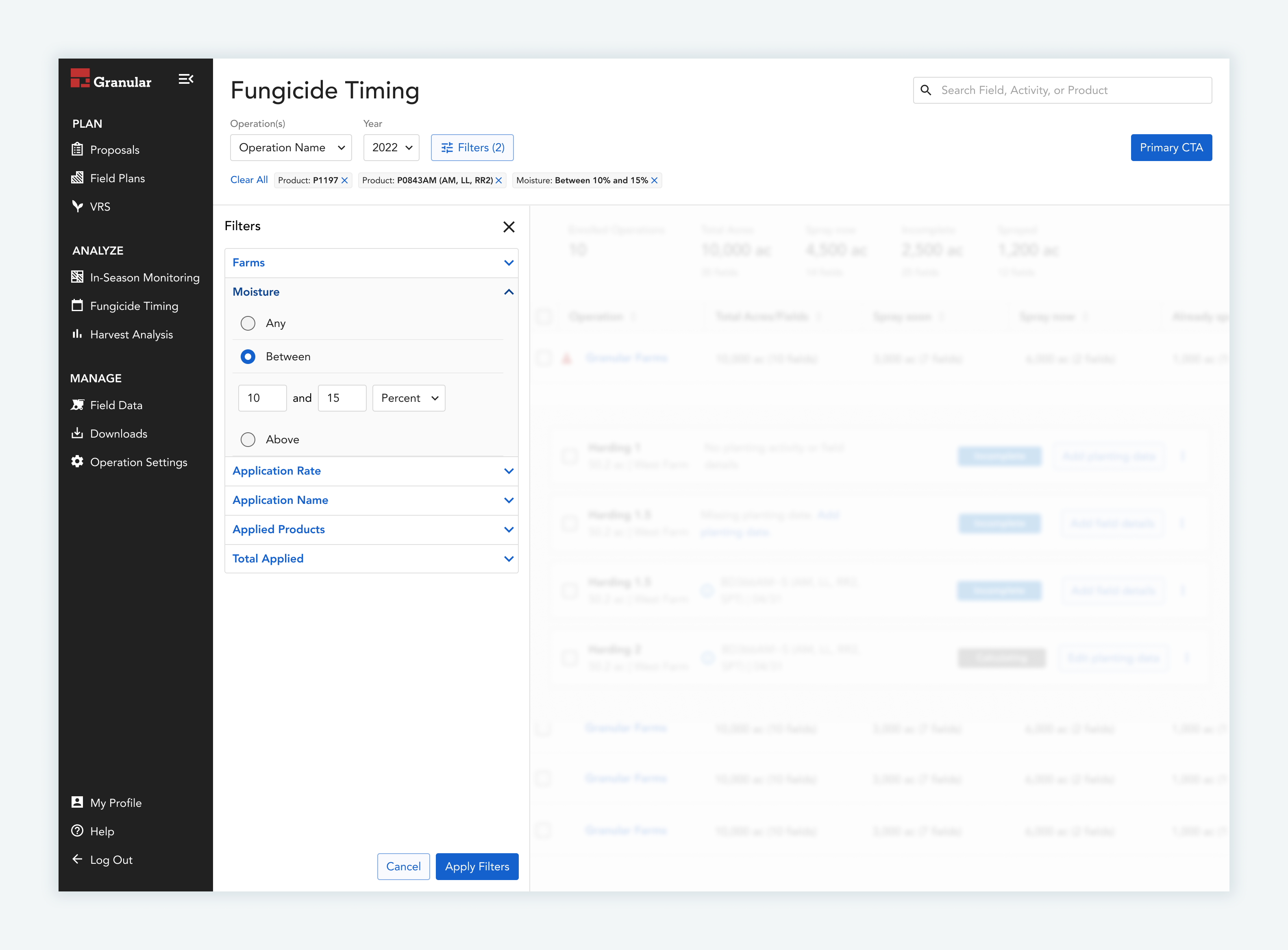
The problem was that the app was organized around the teams that had built it, not around how a rep spends their day. Reps manage customers and data across a lot of farm operations at once, but the old design forced them to work with only one at a time through a select in the global nav. I quickly learned through engineering conversations that simply letting them select multiple operations at once at that level would’ve killed performance. So I pulled the select out of the global nav and onto each screen as part of a "context bar" where reps could choose the exact context a task needed without loading everything all the time. When stakeholders pushed for a simpler all-in-one dashboard instead, I didn’t argue it. I prototyped their version and put it in front of reps, who told us there just wasn’t enough trustworthy data yet for those summary views to be worth much.
Later on, when our research tools couldn’t run the tree test I needed, I built an HTML version myself to find out which structure reps actually found intuitive. I advocated heavily to roll out the navigation changes under an initial opt-in period to manage change fatigue that leadership was concerned about. I worked closely with our design systems team to turn the context bar into a component, handing over designs and documentation to support the creation of the reusable component. Finally, I worked one-on-one with the designers on each product team to fit the context bar into their own spaces to ensure smooth integration across the app.
Outcome: Shipped as the backbone of the New Rep Experience, with the context bar living on as a reusable component adopted across product teams. Success is tracked against rep satisfaction (PVS) and a climb in digital-tool adoption from 25% to 60% by 2026.